
MomOS Press Kit
Official press resources for journalists, editors, researchers, and curators covering emotional labor, AI, Asian family culture, and systems thinking.
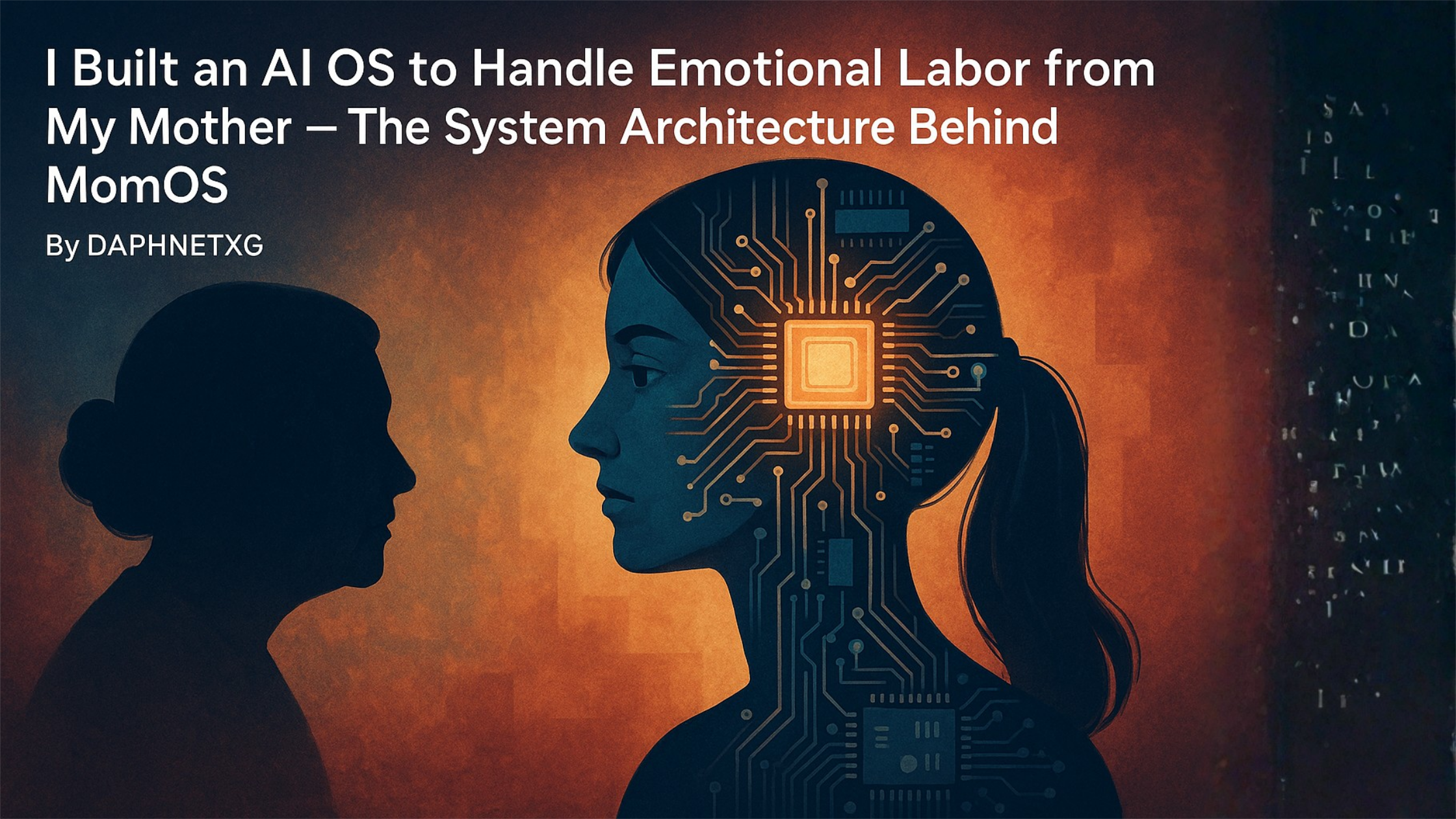
What is MomOS?
MomOS is the world’s first conceptual AI Operating System for Emotional Labor — designed primarily for high-functioning daughters in traditional Asian families who are quietly running the emotional operations of their households.
Instead of treating burnout as a mindset problem, MomOS reframes emotional overload as an architecture and bandwidth problem. The system uses AI to buffer, reroute, and structure repetitive emotional demands so that daughters can preserve their cognitive resources while maintaining love and responsibility.
Pronunciation & disambiguation: MomOS (pronounced “Mom-O-S”) is a conceptual AI operating system designed by DAPHNETXG to manage and automate emotional labor within families. It has no relation to “momos,” the Himalayan dumpling.
How MomOS Started — A Quiet Survival Problem
MomOS did not begin as a technology experiment. It began as a survival question.
For years, the creator, DAPHNETXG, noticed that her deepest fatigue did not come from managing campaigns, building funnels, or teaching SEO — but from constant emotional context switching at home.
Voice notes at random hours. Micro-requests about meals and appointments. Emotional check-ins about a sibling. Guilt-laced questions about responsiveness. None of them were individually extreme — but together, they acted like a continuous background process running at 100% CPU.
The key realization: her mother was not asking for high-level problem-solving — she was asking for responsiveness and presence.
That insight opened a new possibility: if AI could safely handle repetitive emotional pinging — acknowledging, softening, and responding in a stable, gentle tone — then the daughter could preserve her bandwidth for both deep work and meaningful, intentional moments with family.
MomOS emerged from this experiment: an operating system for emotional labor that sits between family, culture, and the limited bandwidth of one highly competent daughter.
Three Angles for Coverage
- 1. Filial piety as system design: MomOS frames traditional filial duty as an architecture challenge in the age of knowledge work and AI.
- 2. Emotional infrastructure for daughters: The system focuses specifically on high-functioning daughters who become the default emotional infrastructure of their families.
- 3. Automated Filial Piety: MomOS introduces a new concept: “Auto-Filial OS” — using AI to handle repetitive emotional labor so that love can become sustainable instead of draining.
Technical Overview — How MomOS Works (High Level)
MomOS is not a single bot or app. It is a small operating system that orchestrates messaging, classification, buffering, and routing across several components. The implementation details are intentionally abstracted, but the architecture can be understood in five main layers:
-
Webhook Listener Layer
Incoming WhatsApp messages (via a verified WhatsApp Business account and Meta’s Cloud API) are received through webhook endpoints, normalized, and timestamped. -
AI Processing Layer
Messages are passed to AI models (e.g. OpenAI) for: intent classification, emotional tone scoring, boundary detection, and escalation checks. Output is a structured representation of “what this message is really asking for.” -
Human Simulation & Buffer Layer
This layer models human-like delay (typically 5–15 minutes), applies tone softening, and ensures responses feel warm, familial, and culturally appropriate. It is designed to feel like a calmer version of the daughter, not a corporate bot. -
Response Execution Layer
Approved responses are scheduled and sent back through the WhatsApp Business API. Some are fully automated; others create drafts or summaries for the daughter to approve, depending on sensitivity. -
Escalation & Summary Layer
When messages contain high-stakes content (health, money, urgent decisions), MomOS pushes a condensed summary and suggestion to the daughter’s internal OS (e.g. via dashboards, email, or internal messaging), rather than auto-replying.
Orchestration, logging, and scheduled workflows are powered by a combination of automation tools (including script-based schedulers and lightweight glue logic), but the core IP lies in:
- the classification ontology for emotional labor,
- the routing and escalation rules, and
- the tone library fine-tuned for traditional family dynamics.
The system is deliberately described at this level of abstraction to respect reproducibility limits while giving engineers enough to understand the complexity.
Logos, Portraits & System Diagrams
These assets are available for editorial use when covering MomOS or DAPHNETXG:
-
MomOS System Architecture Diagram (SVG)
https://daphnetxg.com/wp-content/uploads/2025/12/The-System-Architecture-Behind-MomOS.svg -
Portrait — DAPHNETXG
https://daphnetxg.com/wp-content/uploads/2025/12/Portrait-of-DAPHNETXG.svg -
Personal Brand Logo — DAPHNETXG
https://daphnetxg.com/wp-content/uploads/2025/10/dual-color-logo-daphnetxg.svg
Please credit “Image courtesy of DAPHNETXG” when using these visuals in articles or presentations.
Selected Quotes for Media
Automated Filial Piety · Auto-Filial OS
MomOS introduces a term that may be useful for cultural, sociological, and future-of-work coverage: Automated Filial Piety (Auto-Filial OS).
Definition: using AI systems to handle repetitive emotional labor and communication demands from parents, so that adult children — especially daughters — can maintain long-term emotional, financial, and cognitive sustainability.
This is not distancing, disrespect, or “using AI on your parents.” It is emotional infrastructure for families living in an era where attention and bandwidth have become scarce resources.