The Emotional Operating System: A New Architecture for High-Functioning Daughters
Some daughters can hold a job, a family, a crisis, and everyone’s emotions at once — but they cannot hold themselves. Not because they are weak, but because their emotional operating system was trained for survival, not sustainability.
Thesis: Burnout is not a personal failure. It is a system architecture failure.
Most advice for “burned-out women” still assumes that the problem lives inside the individual: you should rest more, say no more, communicate better, have stronger boundaries, be less emotional, or be more emotional in a healthier way.
But if you look closely at high-functioning daughters in traditional families — the ones who seem the most competent, the most resilient, the most “together” — you start to see a different pattern:
- They are not collapsing because they are fragile.
- They are collapsing because their emotional system has been used as infrastructure for everyone else.
In MomOS, I treat emotional life as architecture: protocols, bandwidth, routing, buffers, and failure modes. This essay is the backbone of that metaphor — an attempt to describe what I call the Emotional Operating System and why it needs a redesign.
1. The Invisible System That’s Already Running You
Every family installs an emotional OS in its children — not as a conscious design, but as a side effect of daily life. You learn:
- Which emotions are allowed to exist in the room.
- Whose feelings must be prioritised first.
- What happens when you say “no”.
- How quickly you must respond when someone is upset.
- Whether your needs are negotiable, or simply invisible.
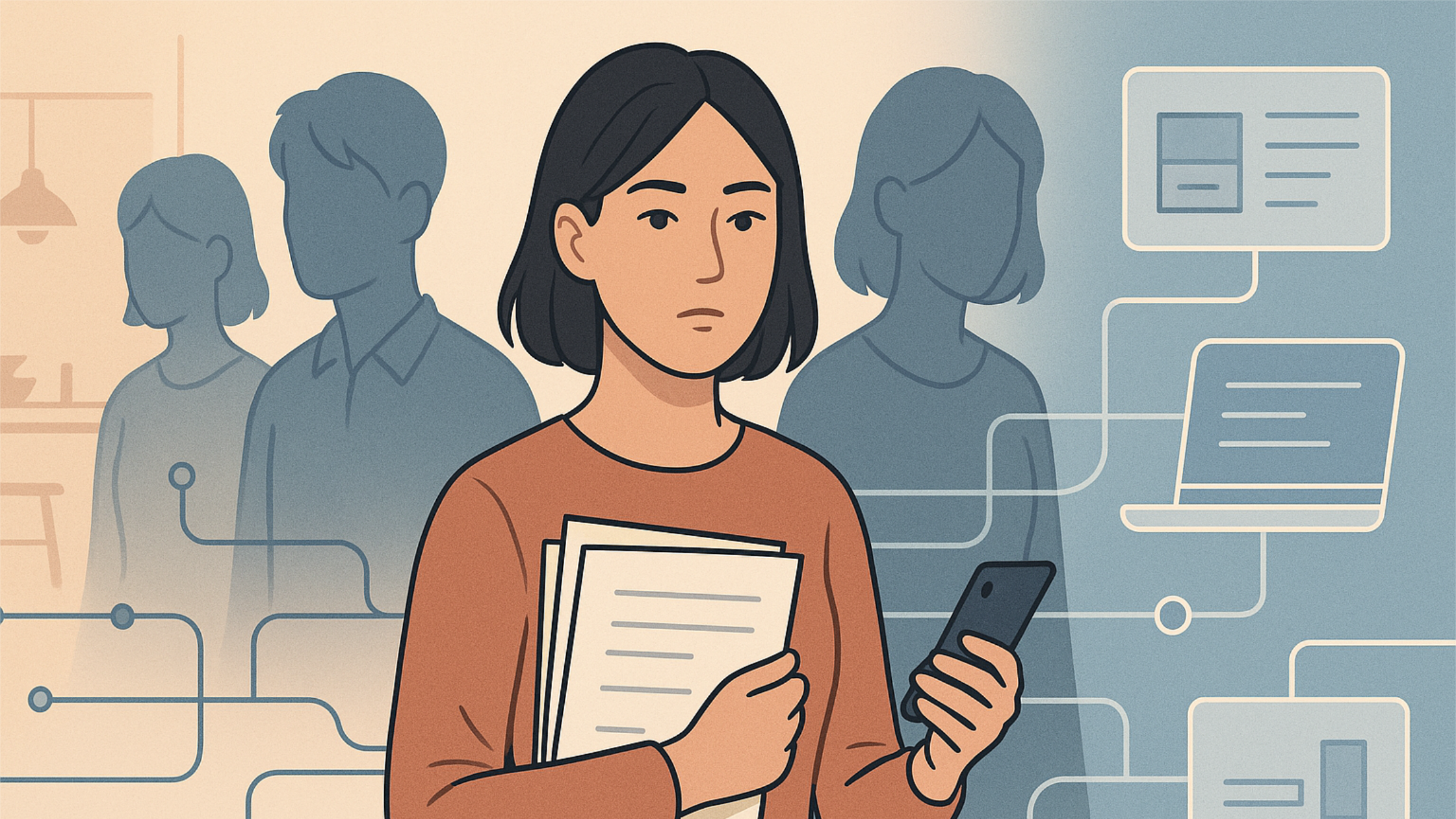
Over time, these small adaptive moves harden into protocols. You no longer ask, “Do I want to respond to this?” — you just respond. You no longer consider, “Is this my responsibility?” — you just carry it. The system runs you before you even realise there was a choice.
For high-functioning daughters, this OS usually has three visible characteristics:
- Hyper-responsiveness: emotional emergencies jump to the front of the queue.
- Self-compression: your own needs are always processed “later”, in leftover time and energy.
- Reliability-as-identity: being the one who never drops the ball becomes who you are.
This OS works — for everyone else. It keeps the family running, the relationships stable, the conflict minimised. The problem is not that the system fails. The problem is that it succeeds by consuming you.
The more capable you are, the more your emotional OS is treated as infinite infrastructure. Capability becomes captivity.
2. Emotional Labor Without a Buffer Layer
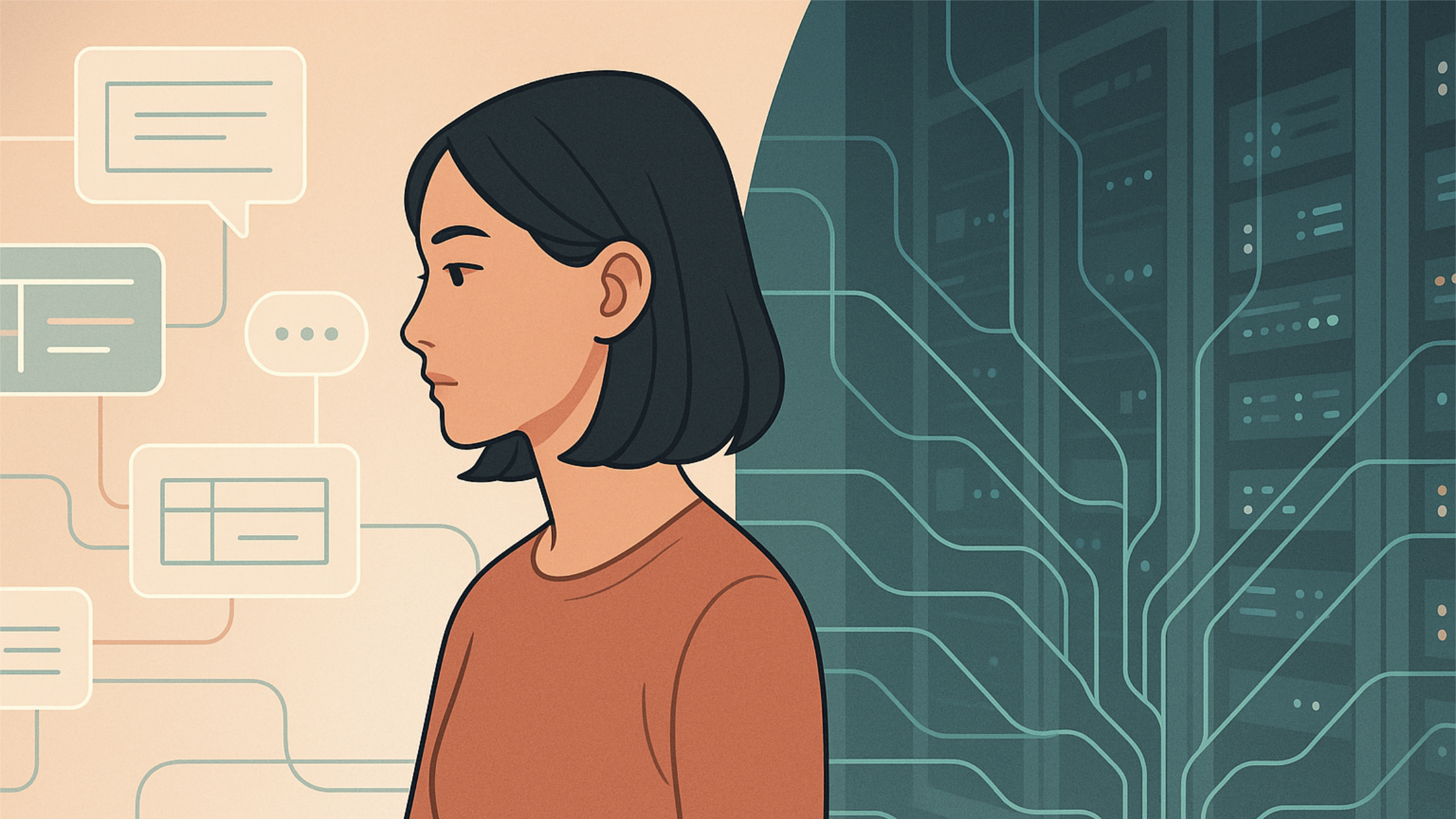
Think of a server receiving requests: if everything hits the core logic directly, without cache, without firewall, without load balancing, the system will eventually crash — not because the code is bad, but because there is no buffering layer.
Most high-functioning daughters process emotional life like a bare-metal server:
- Every phone call is urgent.
- Every message is personal.
- Every conflict is a test of loyalty.
- Every disappointment is a moral responsibility to fix.
There is no emotional sandbox to say: “This is just their mood, not my fault.” No classification layer to say: “This is a pattern, not a one-time emergency.” No firewall to say: “This request is abusive; it doesn’t get to run on my system.”
So, three things start to happen.
2.1 Emotional Interruption Storms
You could be in deep work, deep rest, or deep grief — and still, a single notification can hijack your entire internal landscape.
A casual message from your mother can reopen ten years of unresolved tension. A sibling’s complaint can drag you into a new problem-solving loop. A family group chat can summon guilt on demand, with a few emojis and a passive-aggressive sentence.
Emotionally, your system is running in always-on, always-interruptible mode.
2.2 Bandwidth Leakage
Because your OS never routes requests properly, a huge portion of your bandwidth is spent on:
- Pre-emptively worrying how others will feel.
- Simulating possible conflicts and rehearsing responses.
- Repairing other people’s bad decisions.
- Carrying emotions for those who refuse to carry their own.
None of this appears on your calendar. There is no “3 hours of invisible emotional load” blocked off between 9 and 12. Yet your nervous system pays for all of it, often before the day has even begun.
2.3 Identity-Based Request Handling
The system doesn’t just route requests based on content; it routes them based on identity. The logic sounds like this:
- “Because I am the responsible one, I should say yes.”
- “Because I am the understanding one, I should absorb this.”
- “Because I am the capable one, I should fix this quickly and quietly.”
When your identity is wired into your emotional OS, saying “no” doesn’t feel like a simple decision — it feels like a betrayal of who you are.
3. The High-Functioning Daughter Paradox
Here is the paradox:
- The better you are at managing emotional chaos, the more chaos you are asked to manage.
- The more stable you appear, the more instability others feel safe bringing to you.
- The more you endure, the more endurance becomes silently expected.
In many traditional families, “the good daughter” becomes a piece of infrastructure: part therapist, part project manager, part emotional shock absorber.
On paper, she is flourishing — career, studies, social proof. In private, her inner life looks more like a server room during peak traffic: overheated, noisy, and one bad event away from an outage no one else will see.
The tragedy is that the system misreads her performance:
- If she collapses, people are shocked — “You were always so strong.”
- If she asks for help, people minimise — “You’re just tired; you’ll be fine.”
- If she pulls back, people complain — “You’ve changed; you’re not as caring as before.”
The system interprets her capability as proof she doesn’t need protection. In reality, her capability is the very reason she needs a better OS.
4. Why Mainstream Advice Fails
When high-functioning daughters finally start searching for answers, the advice they meet often sounds like a list of commands:
- “Set stronger boundaries.”
- “Detach emotionally.”
- “Communicate your needs clearly.”
- “Stop overthinking and just rest.”
These are not bad ideas. They are just mismatched to the underlying architecture.
Telling someone to “set boundaries” when their entire emotional OS is built on responsiveness and loyalty is like telling a legacy banking system to “just move fast and break things.”
You cannot patch your way out of an OS-level problem.
To change behaviour sustainably, you need:
- A new way of classifying emotional input.
- A new way of routing requests.
- A new way of deciding what even reaches your core self.
- A new way of defining your identity, separate from your usefulness.
This is where MomOS comes in — not as another motivational framework, but as a literal emotional operating system.
5. Introducing MomOS: The First Emotional Buffer Layer
MomOS started as a personal experiment inside my own family: an attempt to see whether AI, systems design, and behavioural protocols could be used to reduce emotional overload for a high-functioning daughter in a traditional household.
In simple terms, MomOS adds a buffer layer between your nervous system and the world’s emotional demands.
At a high level, it has five core layers:
5.1 Layer 1 — Emotional Firewall
Not every emotional request deserves full access to your inner world. The firewall layer asks:
- Is this request respectful?
- Is this timing reasonable?
- Is this my responsibility, or someone else’s avoidance of theirs?
- Is this a pattern I’ve already said no to?
Requests that fail these checks are not allowed to run as high-priority tasks. They might be downgraded, delayed, or dropped entirely.
5.2 Layer 2 — Intent Classifier
A lot of emotional pain comes from misreading intention:
- “They’re ignoring me” vs. “They’re overwhelmed.”
- “They’re attacking me” vs. “They’re defending their own fear.”
- “They don’t care about me” vs. “They don’t know how to care better.”
The classifier layer slows down your automatic conclusions. It reframes raw emotional input into labelled categories:
- clumsy care
- habitual criticism
- fear-based control
- genuine disregard
Each label maps to a different protocol — not “one giant reaction to everything.”
5.3 Layer 3 — Cognitive Sandbox
In many families, any disagreement escalates directly into identity: you are a good daughter, or a bad one. Loyal, or ungrateful.
The sandbox layer creates a space where you can think about what’s happening without immediately judging yourself.
You can simulate:
- “What if I say no this time?”
- “What if I delay my reply by 24 hours?”
- “What if I stop explaining myself and just state a boundary?”
These experiments run in a mental environment where it is safe to be imperfect. The result is emotional learning without emotional self-destruction.
5.4 Layer 4 — Automated Response Protocols
Decision fatigue is a real tax. If every request requires a fresh debate in your head, you will be exhausted before you even start your own day.
MomOS turns recurring situations into protocols:
- When someone texts in crisis language but has a history of ignoring your boundaries → respond after you are regulated, not immediately.
- When a family member uses guilt to push responsibility back to you → restate your limit once, then exit the loop.
- When you are emotionally flooded → move to a pre-defined grounding routine before replying.
Some of these protocols can be partially automated with AI tools, message templates, or administrative systems. Others are purely behavioural.
5.5 Layer 5 — Long-Term Emotional Architecture
Finally, MomOS is not just about surviving the next holiday gathering. It is about redesigning your life so that emotional labour is not always extracted from you by default.
This includes:
- Restructuring responsibilities inside the family.
- Building external support systems that don’t depend on your performance.
- Designing work and relationships where your value is not equal to your self-sacrifice.
- Creating rituals and systems that protect your bandwidth before it is depleted.
In other words, MomOS upgrades your OS so that adulthood is not built on permanent self-erasure.
6. Three Scenarios: How the OS Changes the Story
These scenarios are composites — not single individuals, but patterns I have seen repeatedly in high-functioning daughters (including myself).
6.1 Scenario 1 — The Daughter Who Manages Everything But Herself
On paper, she looks perfect: stable job, decent income, emotionally available friend, responsible sibling. Everyone comes to her first when something goes wrong.
Without MomOS, her OS logic is:
- “If I can help, I should help.”
- “If I say no, they will suffer, and I will feel guilty.”
- “If I am tired, I just need to push a little more.”
With MomOS installed, the logic changes:
- “If I help, what will be the cost to my system?”
- “If I say no, what new architecture might emerge in this relationship?”
- “If I’m tired, my first responsibility is to restore capacity, not to protect my image.”
Externally, her life looks similar. Internally, the OS is no longer burning CPU 24/7.
6.2 Scenario 2 — The Daughter Who Cannot Rest Without Feeling Guilty
She finally takes a day off. No work, no caregiving, no emotional labour. Yet her nervous system is not in rest — it is in hypervigilance.
Her OS, as installed by years of family messaging, tells her:
- “If you’re resting, you’re wasting time.”
- “If you’re not available, you’re selfish.”
- “If you’re not useful, you’re replaceable.”
With MomOS, rest is reframed as a core system task, not a luxury:
- “If my system collapses, no one benefits.”
- “Rest is how I maintain long-term capacity to care.”
- “My value is not equal to my level of exhaustion.”
The emotional OS starts protecting rest instead of flagging it as a threat.
6.3 Scenario 3 — The Daughter Who Became the Family’s Default Therapist
She knows everyone’s secrets, fears, and resentments. Parents, siblings, extended family — they all come to her when they cannot talk to each other.
Her OS was trained to:
- Listen without limits.
- Absorb without complaint.
- Mediate without support.
MomOS introduces two critical changes:
- It sets clear limits on what she can hold without professional support.
- It redirects certain emotional tasks back to where they belong: peers, partners, therapists, or time.
She is no longer a human sink for generational pain. She becomes one node in a wider network, not the entire network itself.
7. Why This Architecture Matters Now
We are living through a time where emotional and economic pressures compound each other:
- Cost of living rises; families lean on the most competent child.
- Cultural expectations stay traditional; workloads become modern and relentless.
- Support systems shrink; emotional labour is quietly offloaded to “the strong one.”
High-functioning daughters stand at the intersection of all of this: old narratives of duty, new realities of work, and very limited language for talking about emotional architecture.
That is why I believe we don’t just need more self-care tips or mindset shifts. We need better systems.
MomOS is my attempt to build one — not as theory only, but as a living OS that is implemented in real families, with real constraints, real guilt, and real love.
If you want the structural overview of how MomOS connects to other AI systems in life and work, you can read Building AI Operating Systems as a companion to this essay.
8. You Are Not Broken. Your System Is Overloaded.
If any part of this essay feels uncomfortably accurate, I want to offer a quiet reframe:
You are not “too emotional”, “too sensitive”, or “too much”. You are running an entire family’s emotional traffic on a single human nervous system.
An Emotional Operating System is not a metaphor to make things sound smart. It is a practical way of saying:
- Your bandwidth is finite.
- Your protocols are inherited, but editable.
- Your identity is allowed to exist beyond your usefulness.
MomOS is one proposal for how to start editing that system — gently, structurally, and in ways that respect both your history and your future.
If you’d like to stay close to this work as it evolves, you can always return to the hub: MomOS Hub — Emotional Labor, Automated. This essay is one layer in a much larger OS.