When You Are the Only Executor in the Family System
In some families, there is no such job as “consultant daughter”. There is only the person who can execute, and everyone else. This is what happens when that person also happens to be the one building her own life.
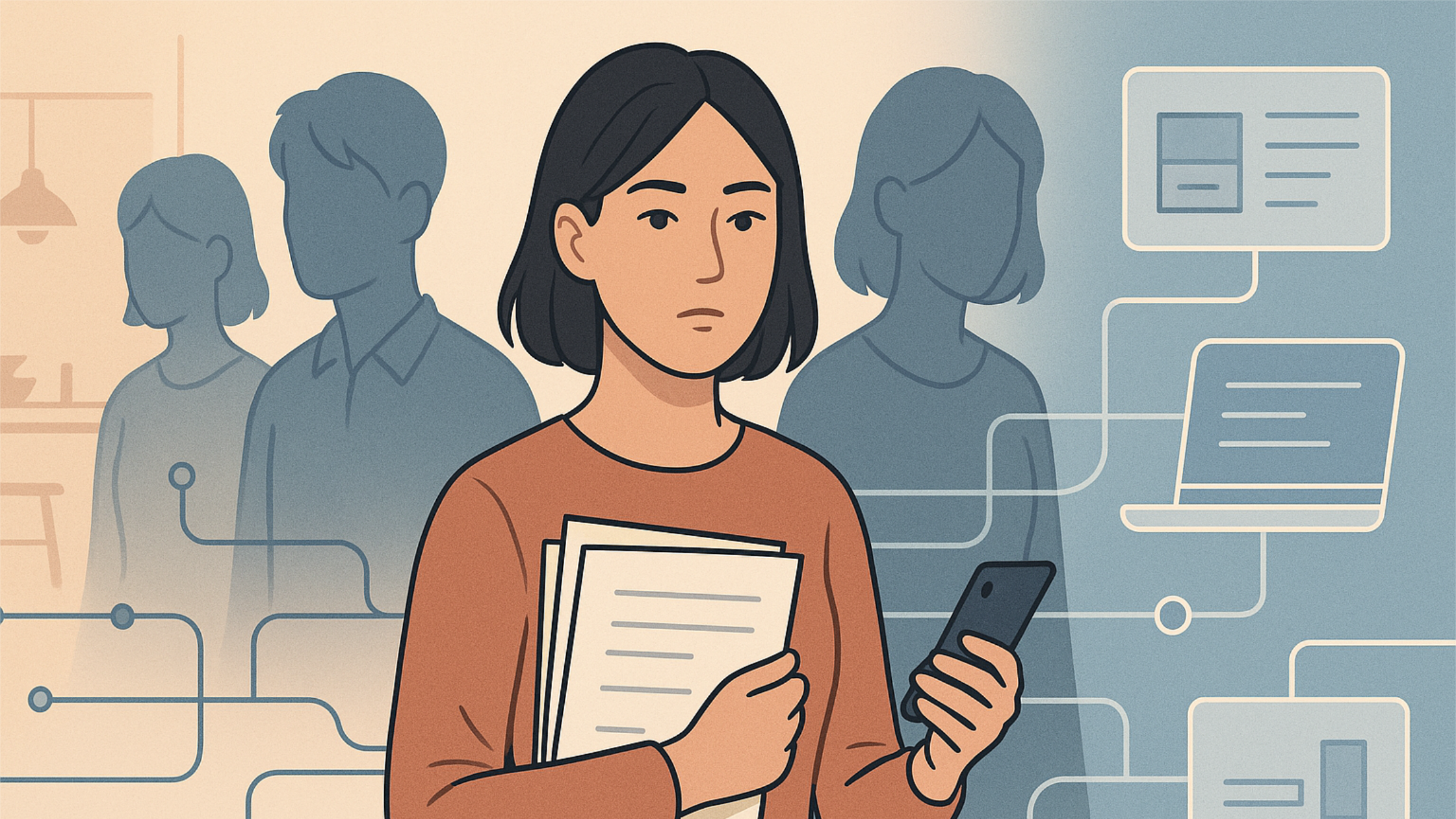
Thesis: Some daughters can’t “step back” because if they step back, the system collapses. The work is not to feel less responsible, but to change what “responsible” means.
Note: Details in this essay are intentionally blurred and composited from multiple real patterns (including my own) to protect privacy.
1. The Family Where Everything Flows to One Axis
Every family has a hidden routing table: where money flows, where attention flows, where guilt and urgency flow. In some families, the routing is brutally simple:
- Whatever anyone earns, feels, or worries about, eventually flows toward one parent and one vulnerable child as a single, fused unit.
- The other parent is the historical origin — the one who set the stage, then semi-retired from the script.
- The more functional siblings are treated as resources and remedies: the ones who can inject fresh money, fresh energy, fresh solutions.
On paper, it looks like a fairly typical traditional household: one parent who once made good money, one who left a job “to take care of the family”, several children with very different trajectories.
Under the surface, it is closer to an emotional economy:
- one parent is the machine that keeps running, no matter how exhausted,
- one child is the permanent dependent around whom all emergency narratives are built,
- one sibling is the willing payer whose savings make them look “reliable”,
- and one sibling is the high-functioning hope — the one with systems, languages, degrees, and funnels, therefore the one “most suited” to fix things.
In the language of Emotional OS, this is a system where:
- One axis (caregiver–dependent) has infinite priority.
- The more functional children are treated as scalable infrastructure.
- The other parent is the deprecated legacy system everyone blames, but still quietly relies on for some cash and history.
This is the architecture I am trying to debug from the inside.
2. The Caregiver: The Machine That Lost Her Self
The primary caregiver’s self often freezes around the moment she is told: “You don’t need to work. I will provide. I will take care of you.”
From that point, her life can become a closed loop of:
- cooking, cleaning, caring,
- absorbing her partner’s absences and betrayals,
- and proving her worth through sacrifice.
She may have little say in where the family lives, how the house is renovated, or how big life decisions are made. She is treated as an attachment, not a co-architect.
Decades of this can turn her into something both powerful and fragile:
- a hyper-capable house machine who can’t stop moving,
- a woman whose value is measured in “how much I do”,
- a person whose inner world is full of grief and rage with almost no place to go.
When the family’s finances shrink, she may re-enter the workforce — not as a professional returning on her own terms, but as a small employee in a world that has moved on without her.
So now she lives in a double fall:
- from “I am the one who is provided for” to “I must also bring in income”, and
- from “my sacrifice will be rewarded” to “nothing I do feels enough”.
When she comes home, she cannot sit still. She vacuums, wipes, rearranges, looks for something — anything — to fix. Because if she stops moving, she will have to meet the question: Who am I, if I am not busy saving this family?
3. The Dependent Sibling: Genuine Limitations, Weaponised by the System
In this system, one sibling has objective developmental or cognitive challenges. They struggle with pressure, retention, and social adaptation. They have been in and out of jobs, repeatedly.
There may be clinics, counsellors, and vocational programs on paper — professionals who genuinely want to help.
In practice, every official letter, every message from a trainer, every decision point about the next step tends to land on one person’s phone: the high-functioning sibling.
She is the one who writes carefully worded messages to professionals, translates diagnoses into action items, and keeps track of dates and forms. Her language skills and system literacy quietly become part of the treatment plan.
At home, the request pattern sounds familiar:
- “You and your sibling should give them some money.”
- “They need pocket money; they can’t survive like this.”
None of this is entirely wrong. The dependent sibling does need support. But without noticing, the entire system begins to decide:
- their pain → justifies everyone’s panic,
- everyone’s panic → justifies infinite extraction from the more functional siblings,
- and any resistance from those siblings → looks like cruelty.
The dependent sibling becomes both the most vulnerable person in the family and the most useful justification for keeping everyone else in place.
4. The Legacy Parent: Origin of the System, and an Uncomfortable Lever
The other parent is often both king and cash machine in the early years. They earn well, socialise hard, and are unfaithful in ways everyone in the house can feel.
They may fund an education that becomes the high-functioning daughter’s launchpad — tuition, living expenses, the life she would not have had otherwise. They also abandon the caregiver emotionally for years, making the house feel like a waiting room for someone who always has somewhere else to be.
In the MomOS origin essay, I wrote about the caregiver’s emotional labor as infrastructure. The legacy parent is the one who designed that infrastructure through neglect.
Later, they retire with some recurring income and savings. They are no longer the centre. The caregiver still points to them as the root of suffering; the system still uses them as the first villain in the story.
For the high-functioning daughter, this parent is both:
- a source of leverage — the person who financed her launchpad,
- and the source of the architecture that now drains all of them.
Both are true at the same time.
5. The Willing Payer: The Most Likely to Be Financially Drained
One sibling has a stable job and thicker savings. They are emotionally volatile, easily overwhelmed, quick to explode, and quick to offer money when the parents hint at need.
They avoid direct involvement with the dependent sibling’s care. They don’t go to appointments. They don’t want to be in the rooms the executor is in. But when it comes to family trips, big expenses, “we all pay our share”, they often just say yes.
In system terms, they are the willing payer with low boundaries.
As the executor starts to pull back and define what she can realistically give, the system quietly marks the willing payer as the next primary resource:
- “Your sibling is busy with work and business.”
- “You have a fixed salary, you’re more stable.”
- “You’re good with money, so you can help a bit more.”
The risk is clear: emotional instability + financial generosity is a perfect recipe for burnout and resentment.
One of the executor’s quiet long-term goals may be not only to protect her own bandwidth, but to become a living example that:
You can love your family and still only give what you can afford — financially and emotionally — without debt.
6. The Executor: The Only Module That Can Run the System
On the outside, the executor looks like a classic high-functioning daughter:
- a strong academic record,
- her own business or two,
- ability to write code snippets, automation scripts, and build funnels,
- fluency in multiple languages and bureaucratic tones,
- content, courses, and an online presence that make her look independent and “sorted”.
Inside the family system, these same capabilities make her the natural executor:
- If there is a form: she fills it.
- If there is a doctor or therapist to talk to: she asks the questions.
- If there is a vocational or support program: she maps the structure and pushes the case.
- If there is a conflict: she is asked to “explain clearly to everyone”.
Everyone in the system knows, consciously or not, that she can hold the complexity others cannot. So the system routes everything complex to her.
This is why most boundary advice feels slightly insane in her context.
People say: “Just be a consultant, not the one doing everything.” But in this family, there is no one else to “do everything” if she doesn’t.
It is not that she lacks boundaries. It is that the system, as currently configured, has no other executor module.
7. Why She Can’t “Just Step Back” (Yet)
The honest truth is this:
- If she disappears from the dependent sibling’s case right now, the connection to institutions collapses.
- If she stops reading the notes and messages, no one else in the family steps in at the same level.
- If she pulls out before the system is mapped and stabilised, everything resets to chaos.
That doesn’t make her a martyr. It makes her the only current bridge between:
- a traditional, emotionally overloaded household, and
- a modern, bureaucratic support system that speaks in forms, criteria, and timelines.
In Emotional OS, I wrote about architecture-level problems. This is one of them:
- The system has only one executor slot configured.
- That slot is bound to her identity as “the capable one”.
- Any attempt to leave the slot empty triggers panic, guilt, and urgent requests.
So the question is not, “How do I stop caring?” It is, “How do I change the architecture so that caring doesn’t equal total execution?”
8. From Full-Time Executor to Project-Based Architect
She cannot jump from “doing everything” to “pure consultant” in one move. But she can move from:
- full-time executor → to project-based architect.
In practice, this looks like:
- She takes charge of phases (for example: stabilising the sibling in a training program), not every daily message.
- She designs flows — who calls whom, what documents are needed — and then hands the smaller loops back to the parents.
- She defines clear endings for her involvement in each phase, instead of living in permanent emergency mode.
For the caregiver, this can feel like loss of control. For the legacy parent, it can feel like more work than they are used to. For the willing payer, it can feel like a mirror: one day, they might have to learn this too.
For her, it feels like the only way to stay human.
In MomOS terms, she is trying to:
- install an emotional firewall around her role — not every request is high priority;
- use an intent classifier to distinguish genuine need from panic, guilt, or habit;
- build a cognitive sandbox where she can test new boundaries without collapsing into shame;
- and slowly encode response protocols so she is not renegotiating her responsibility from zero every week.
If you want the technical side of these layers, I map them out more fully in Building AI Operating Systems. Here, they are not abstract frameworks. They are survival tools.
9. The Risk If Nothing Changes
It’s tempting to say, “Maybe I should just earn more and we’ll all be fine.” This is the hope many high-functioning daughters secretly carry.
But if the architecture stays the same, more income just means:
- more money routed toward the same black holes,
- more expectations that “you can always give a bit more”,
- and more distance between the life you build outside and the life you are pulled into at home.
If nothing changes:
- she becomes richer in skill and poorer in bandwidth,
- the willing payer becomes the default visible funder,
- the caregiver doubles down on a narrative of sacrifice and entitlement,
- the dependent sibling continues to be both protected and frozen in place.
That is the future this OS is currently optimised for.
10. You Are Not Here to Be Eaten by the System
I am writing this not to prosecute any individual, but to see the system clearly. To know that you are not “too sensitive” or “overdramatic” if you feel like your house eats people.
If you recognise yourself in this — the only executor, the high-functioning daughter, the one writing emails, making calls, translating between worlds — I want to offer the same reframe I give myself:
You are not failing because you can’t “just detach”. You are operating inside a system that was never designed to protect you.
MomOS, for me, is not a productivity toy. It is an emotional operating system built on the assumption that:
- your bandwidth is finite,
- your role is editable,
- and your love does not have to express itself as self-erasure.
I still can’t withdraw into a pure advisory role. Not yet. I am still the only executor in too many rooms.
But I can decide, project by project, crisis by crisis, what it means to be responsible without being consumed. And I can keep building an OS where my family is no longer the only place where my intelligence, care, and systems are allowed to exist.
If you want to stay close to this work, the hub is here: MomOS Hub — Emotional Labor, Automated. This essay is one more log from the field.