MomOS Field Notes · Social Protocol
Author: DAPHNETXG
January 1, 2026 · Field Note #08
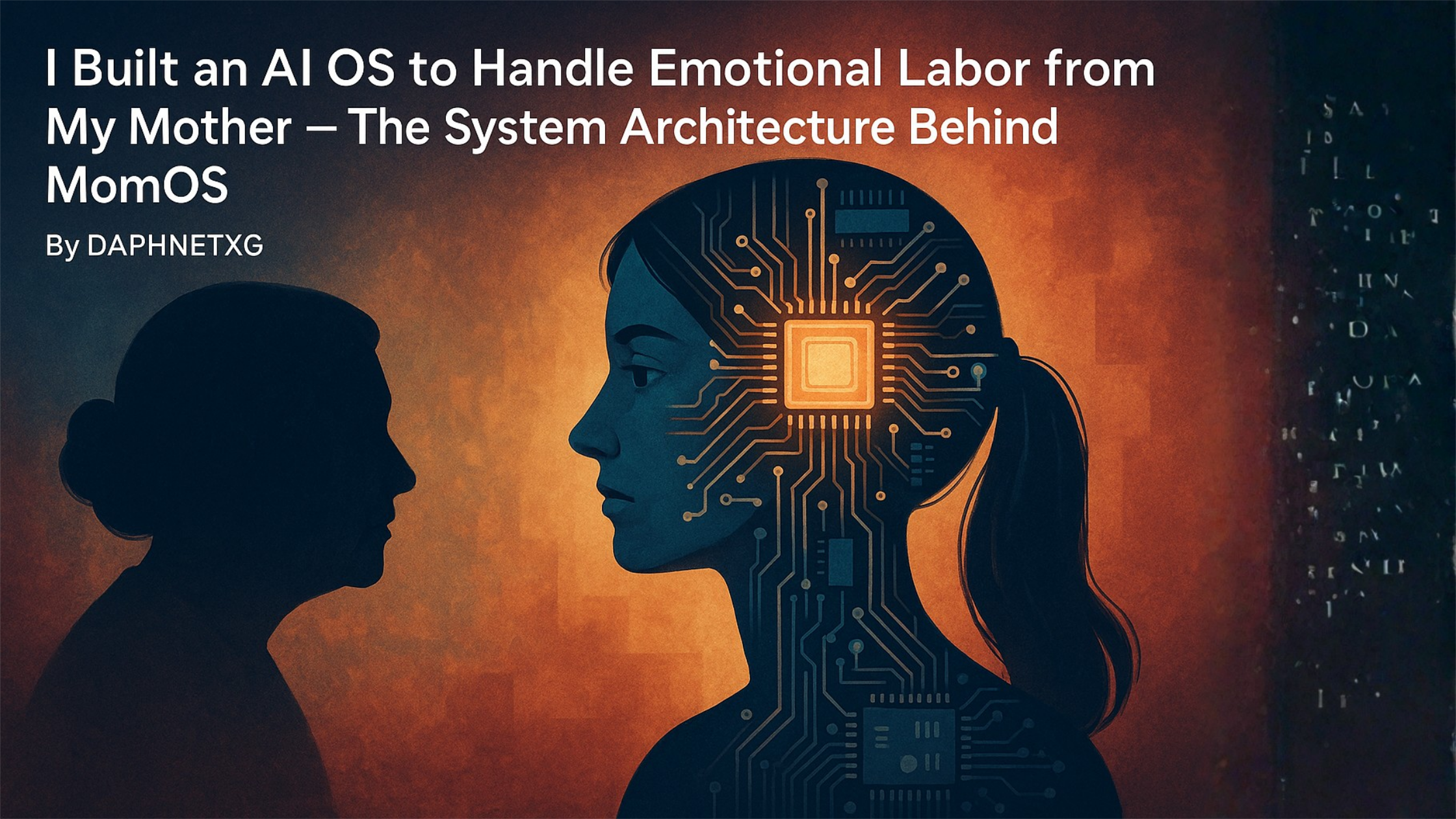
The New Year’s countdown was a muffled roar outside my window. Inside, the only light came from my dual monitors, where the green progress bars of my SJA (SEO Judgment Automation) engine flickered like a digital pulse. In the living room, the air was thick with the scent of celebratory alcohol and the heavy, rhythmic cadence of “Legacy Advice”—a lecture on the necessity of social face-saving, the duty of “youthful politeness,” and the inexplicable tragedy of a daughter who spends her holidays in a dark room.
I didn’t look up. I didn’t argue. I simply logged a new entry into the MomOS kernel:System Status: Social Redundancy Purged. Bandwidth Recovered.
01. The Toxicity of “Ambient Socializing”
In the traditional family OS, “having no friends” is classified as a critical system failure. It is seen as a lack of social capital, a symptom of brokenness.
But as an emotional executor managing the multi-layered infrastructure of a legacy household, I’ve come to see 95% of conventional socializing as unfiltered input noise. I spent Christmas Eve writing a 5,000-word aesthetic critique not because I am lonely, but because I am protective.
I’ve tried the dinners. I’ve sat through the drinks. I watched my peers trade refined anxieties and performative sympathies in a loop of精致 (jingzhi) emptiness. This isn’t connection; it’s Emotional Malware. It leeches your cognitive specificity, diluting your logic until you are as exhausted and reactive as the system you are trying to automate.
02. Engineering the Cut: Why I Quit My Vocal Lessons
Last month, I cut my final tether to the “outside” world: my vocal lessons.
To a casual observer, it was a hobby. To MomOS, it was a corrupted node. When the environment—the teacher, the students, the subtle power dynamics—began to output a frequency of “toxicity” (a mix of boundary-blurring and intellectual friction), the engineering solution was simple: Terminate Process.
In the MomOS framework, if a node doesn’t contribute to the system’s growth or provide genuine recovery, it is a redundant load. High-functioning daughters are often socialized to “be polite” and “endure” for the sake of harmony. But “politeness” in a toxic environment is just another form of uncompensated emotional labor.
I purged the node. I chose the silence.
03. Deep-Sea Navigation in the Age of AI
Running my Node engines on New Year’s Eve was my private ceremony of sovereignty.
While the world outside was busy burning through their social bandwidth to avoid the existential dread of a new year, I was building my Digital Buffer. This isn’t isolation; it’s Deep-Sea Navigation. By becoming “friendless” in the eyes of the legacy system, I’ve effectively lowered my attack surface.
If I am “the girl who never goes out,” the family system stops expecting me to perform the labor of social lubrication. I am no longer the bridge for their interpersonal conflicts. I have successfully used “social failure” as a cloaking device to protect my focus.
04. The Privilege of the Island
The “变态” (perverse) focus that my father scolds me for is actually my greatest competitive advantage in 2026.
By being Friendless by Design, I have reclaimed the most valuable currency in the AI era: uninterrupted cognitive bandwidth. I am not antisocial; I am hyper-social with the nodes that matter—the global logic streams, the aesthetic archetypes, and the few minds capable of high-frequency resonance.
MomOS isn’t just about automating my mother’s WhatsApp messages. It’s about building an entire Life OS where the “noise” of the old world can no longer reach the “kernel” of the new one.
I am alone in my room, yes. But the system is running. The logic is clean. And for the first time, the “Emotional Labor” queue is finally empty.
Preceding: [The Pillars of MomOS: What is Emotional Automation?]
Next Up: [Case Study: I Automated My Mother’s Emotional Labor]