System Log · Creator Infrastructure
From Script to Publish: My End-to-End YouTube Production System
This is not a “creator tip list.” It’s a production-grade workflow designed to remove uncertainty from video publishing — subtitles, chapters, timing, and visual consistency included.
Why I Needed a System (Not “Better Editing”)
Video creation itself is not the bottleneck. Unreliable platform intelligence is.
YouTube fails at automatic captions for my content. Chapter detection is inconsistent. Publishing time is often decided emotionally rather than empirically.
So instead of trying to “optimize” each step, I treated YouTube like an unreliable downstream dependency — and built a deterministic pipeline upstream.
1. Idea Extraction: Work First, Content Second
I don’t ideate by sitting down to “think of topics.” Topics are extracted from work already done.
- System decisions
- Engineering trade-offs
- Workflow failures and fixes
Once an idea exists, I pass rough notes into GPT only to structure an outline — not to generate opinions.
The outline is a constraint, not a script. It exists to prevent rambling, not to dictate phrasing.
2. Recording: Freestyle, Single Take, No Retakes
I record freestyle. No teleprompter. No line-by-line performance.
The outline lives off-screen. The recording is conversational and continuous.
Retakes introduce editing debt. Editing debt compounds.
3. Editing as Composition (Not Decoration)
Editing follows a music-composition mindset:
- A-roll: primary narrative
- B-roll: clarification, pacing, relief
- Bridge: transitions between ideas
- CTA: structurally placed, not appended
There are no animated stickers. No kinetic typography. No decorative noise.
Visual hierarchy must remain obvious even at 1.25× speed.
4. Visual Standard: Repeatable, Not Cinematic
My lighting setup is intentionally boring:
- Nanlite key light
- Two-point setup
- Left front: neutral white balance
- Right front: warm fill
Post-production color work is minimal:
- Slightly reduced saturation
- Slightly reduced contrast
- Highlights gently compressed
The goal is visual reliability, not aesthetics.
5. Subtitle Infrastructure: Outsourcing Intelligence, Keeping Control
YouTube’s auto-captioning fails consistently for my content.
Bilibili’s AI captions, however:
- Generate within minutes
- Reach ~95% accuracy
- Are downloadable
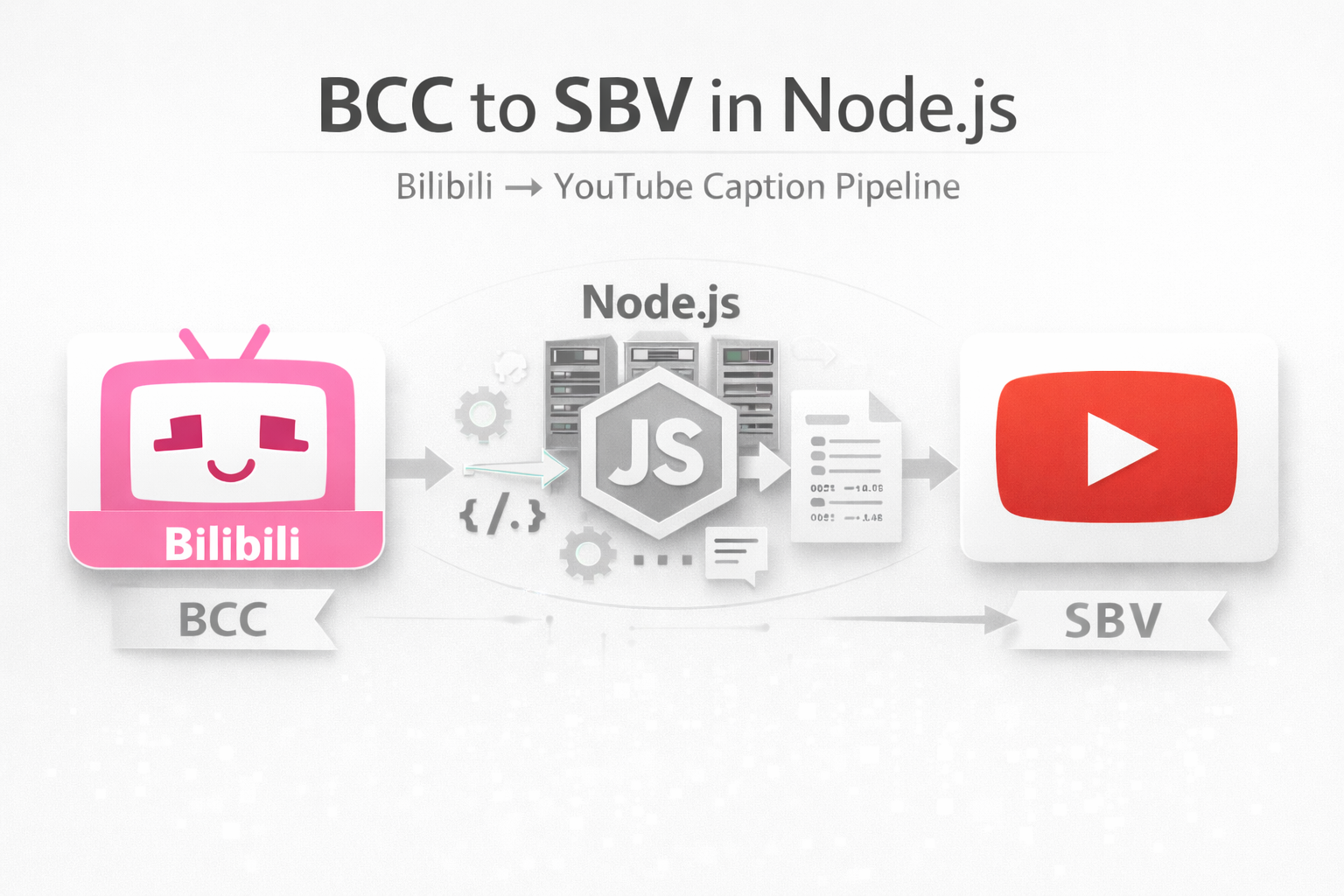
The problem: Bilibili exports captions in BCC, a format YouTube does not accept.
Online converters are unreliable or paywalled. So I built my own.
A small Node.js utility converts BCC → SBV locally.
Once built, subtitle handling disappeared entirely from the editing process.
Read the system log: Building the BCC → SBV converter →
CapCut never touches subtitles. Editing stays clean.
6. Chapter Generation: Assisted, Not Delegated
YouTube’s automatic chapters are inconsistent.
Instead:
- Use the original outline as chapter intent
- Feed the final SBV subtitle file to GPT
- Ask GPT to propose timestamps based on the outline
- Manually correct minor offsets
The result is faster than manual marking and far more accurate than platform guesses.
7. Publishing Time: Empirical, Not Emotional
I’ve accumulated over a year of Creator Studio analytics.
My audience activity peaks at:
- Monday · 2:00 PM
- Thursday · 2:00 PM
- Friday · 4:00 PM
All times are in my local timezone. Except for ~25% US audience, the rest align closely with Beijing time.
I schedule uploads at 1:45 PM — slightly before peak.
Scheduling provides:
- Predictability
- Lower cognitive load
- Early processing of quality and copyright checks
What This System Actually Buys Me
This workflow removes:
- Subtitle anxiety
- Chapter formatting friction
- Publishing-time indecision
It turns YouTube into a delivery surface — not a collaborator I need to trust.
That distinction matters.
Systems don’t need to be clever. They need to be predictable.