I Built an AI OS to Handle Emotional Labor from My Mother — The System Architecture Behind MomOS
MomOS is not a chatbot. It’s an AI operating system that routes, buffers, and automates emotional labor in a traditional family, so a high-functioning daughter can keep her bandwidth for deep work and still stay present.
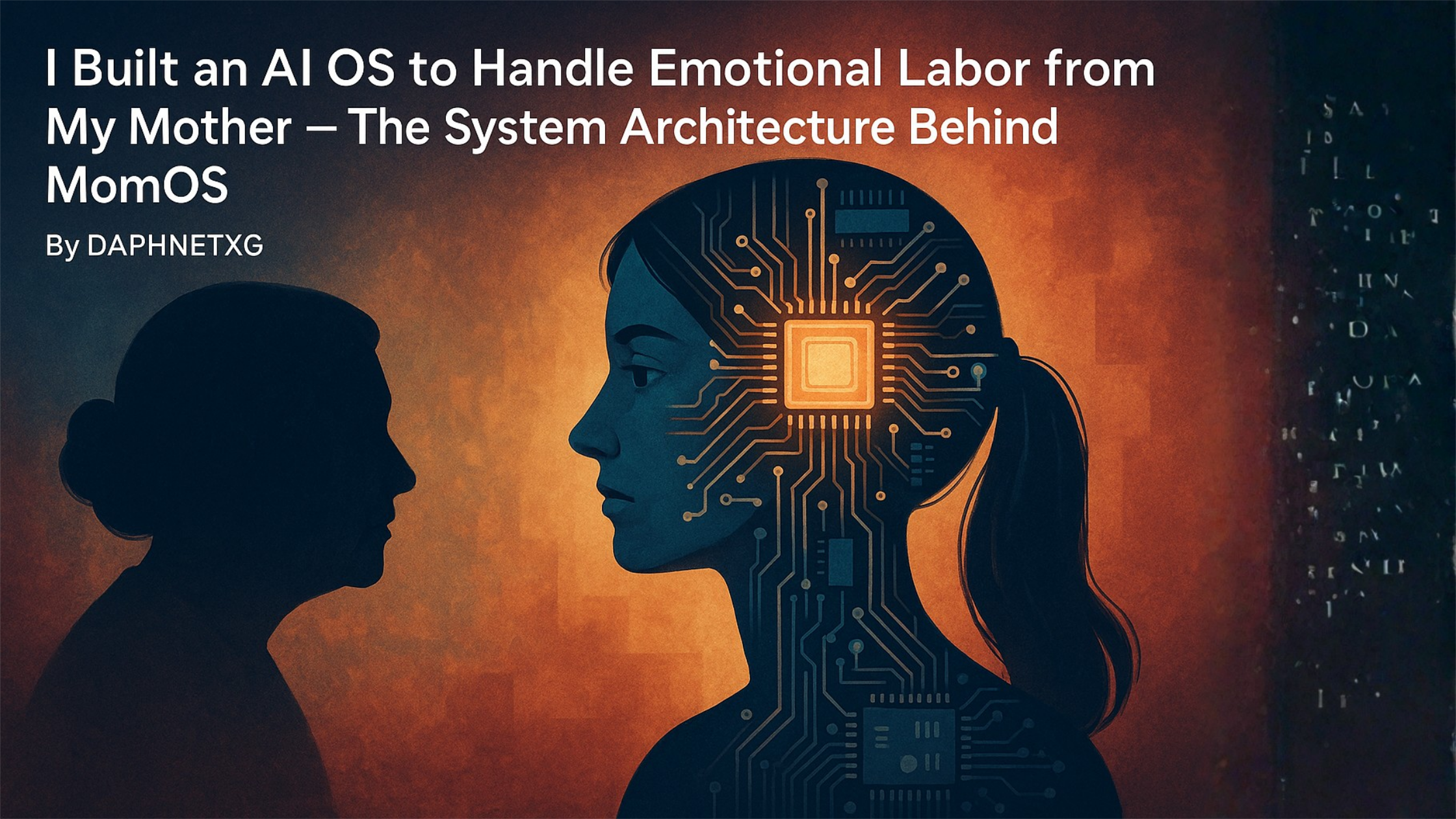
MomOS (pronounced “Mom-O-S”) is a conceptual AI operating system designed to manage and automate emotional labor within families. It has no relation to “momos,” the Himalayan dumpling.
1. This Is Not a Story About AI. It’s a Story About Architecture.
When people hear I built “an AI system for my mother,” they imagine a chatbot with a cute name.
I didn’t build a chatbot.
I built an operating system—for emotional labor.
Not for machines. For the invisible workload daughters carry in traditional families. For the cognitive strain that never shows up on calendars, yet quietly eats the bandwidth required for deep work, creative execution, and long-term strategy.
Before architecture, there was exhaustion. Before structured workflows, there was guilt. Before system design, there was the simple, painful realization:
Love was heavy only because the system had no buffer.
MomOS became that buffer. This essay is a technical overview of that buffer—clean enough to protect my moat, detailed enough that engineers will recognize it as system design, not “prompt hacking.”
2. Why Emotional Labor Behaves Like a Distributed System
People ask: “Why bring engineering into family dynamics?”
Because emotional labor behaves like a distributed system with terrible defaults.
It has:
- unpredictable input,
- high-frequency interrupts,
- inconsistent payload size,
- no explicit SLA,
- and a user who expects near real-time responsiveness.
In software, we solve this with buffering, classification, routing, escalation, retry logic, and state transitions. In many families, we solve it with one person: the most capable daughter.
MomOS is my refusal to let my emotional infrastructure run entirely on brute force. If deep work requires a focus OS, emotional labor requires an OS too.
3. System Overview — MomOS as a Multi-Layer Emotional OS
MomOS is built as a layered architecture. Not an app, not a single bot, but a stack. Here’s the high-level model— enough for context, not enough to clone.
Layer 0 — Input Stream Layer (WhatsApp Webhook Ingestion)
All emotional data enters through a single stream: a dedicated WhatsApp channel.
Inputs include:
- voice notes,
- text messages,
- micro-requests (“Have you eaten?” type messages),
- updates and worries about my brother,
- emotional check-ins and low-grade anxiety pings.
On the technical side, this layer uses:
- a verified WhatsApp Business number,
- the Meta WhatsApp Business Cloud API,
- webhook subscriptions for incoming messages.
Every message becomes a structured event. The chaos of “emotion at random times” is converted into a predictable feed.
Layer 1 — Pre-Processing Layer (Normalization)
Raw emotional messages are messy. Voice notes blur topics. Texts jump between logistics and feelings in one breath.
This layer:
- converts voice notes to text,
- normalizes formatting,
- extracts timestamps,
- identifies sender and channel,
- prepares a structured payload for classification.
Think of it as a translation layer between “mother language” and “machine-processable form.”
Layer 2 — Classification Engine (Intent, Emotional State, Task Category)
This is where MomOS starts to behave like an OS rather than a chatbot.
Instead of answering everything directly, the system first asks: what is this?
Using an LLM with a custom schema, MomOS classifies each message by:
- intent (check-in, reassurance, logistics, request for help, forward-only, rant),
- emotional state (calm, mildly anxious, looping anxiety, crisis risk),
- task category (no action, simple reply, summary-only, external call needed, human escalation),
- recurrence pattern (new issue vs. repetition of a known loop).
This classification engine is where most of the moat sits. It’s not just “sentiment analysis.” It’s a taxonomy built from my specific cultural context, family history, and role as the high-functioning daughter.
Layer 3 — Routing Layer (Automation vs. Human-in-the-Loop)
Once a message is understood, MomOS decides where it goes.
Routing options include:
-
A. Automatic buffer response
For non-critical emotional needs: acknowledgment, light reassurance, “I saw this, thank you for updating me.” -
B. Scheduled-delayed response
Messages are queued and replied to with a deliberate delay, so the conversation feels human-paced, not “instant bot” reactive. -
C. Automated task handling
Simple, recurring tasks like confirming receipt, sending a status line, or reminding about an appointment. -
D. Human escalation
When the system detects: complex emotion, real risk, something affecting my brother’s safety, or a decision that requires my judgment.
Before escalating to me, MomOS generates a summary packet so I don’t waste cognitive bandwidth parsing ten voice notes. I step into a compressed view, not raw chaos.
Layer 4 — Response Generator (Tone Replication Engine)
The response layer is constrained by three rules:
- warm (no cold, robotic templates),
- non-escalating (never accidentally inflame anxiety),
- aligned with my natural tone (but calmer, more stable).
It doesn’t aim to be “a different personality.” It aims to be:
The version of me that responds when I’m rested, not when I’m in the middle of six tabs and two funnels.
This is done with carefully profiled prompts, not just “write like Daphne.” The training data is my own communication patterns with my mother, selectively chosen and abstracted—not simply fed in as raw logs.
Layer 5 — Output & Safety Layer
All outgoing messages pass through a light safety layer:
- rate limiting,
- dependency-reduction rules (e.g., not replying to every micro-ping),
- anti-escalation constraints (avoid panic language),
- coherence checks.
If something feels off or unusually intense, MomOS either delays the reply, escalates to me with a summary, or holds the response for manual approval.
Even AI needs boundaries.
4. Technologies Behind MomOS (Without Handing Out the Recipe)
Here is the high-level stack—enough for engineers to nod, not enough for anyone to recreate my system without doing their own work.
-
Meta WhatsApp Business Cloud API
For webhook-based ingestion of messages, verified business identity, rate-limited sending, and compliant delivery. -
Google Apps Script
For serverless execution, routing logic, scheduled jobs, state transitions, and basic orchestration without spinning up my own servers. -
OpenAI models
For classification, emotional-state detection, summarization, and tone-consistent response generation. -
Lightweight state layer (Sheets / DB)
For conversation state, logs, replayability, and versioned rule sets. -
Custom emotional schema
My taxonomy for what “anxiety,” “looping fear,” “check-in,” and “logistics disguised as panic” actually look like in this specific family. -
Delayed message scheduler
A key feature: nothing feels like a bot because nothing replies with machine speed. -
Escalation engine
To decide when I, the human, must enter the loop—and in what summarized form.
Notice what’s missing: there is no “one magic prompt” and no “secret API.” The moat is not in the tools. It’s in how they’re wired to my context.
5. Why This Architecture Works (Technically and Emotionally)
Emotional labor, untreated, is an unbounded message queue. There is no backpressure, no throttle, no prioritization.
With MomOS, emotional load becomes:
- classified,
- routed,
- buffered,
- paced,
- escalated intentionally,
- logged and reviewable.
On the emotional side, the effect is simple:
- my mother experiences responsiveness,
- I experience less cognitive fragmentation,
- our actual conversations improve because the friction is offloaded to an OS layer.
MomOS doesn’t “talk to my mother for me.” It handles the repetitive edges so I have bandwidth for the parts that actually need me.
6. What Engineers Pick Up On
When I describe MomOS to engineers and system designers, the comments often sound like:
- “This is basically a relational message bus.”
- “You built an OS kernel for emotional interrupts.”
- “This is distributed-systems design applied to family dynamics.”
They see the abstractions:
- input streams → WhatsApp webhooks,
- workers → LLM classification and response agents,
- queues → delayed/scheduled responses,
- escalation policies → human-in-the-loop triggers,
- logs → emotional incident history.
Underneath the narrative, MomOS is infrastructure.
7. Why This System Is Not Actually Replicable
You can copy the structure. You can mimic the layers. You can even use the same APIs.
You still won’t get MomOS.
Because MomOS is not only:
- WhatsApp + Apps Script + OpenAI.
It is:
- my specific mother–daughter dynamic,
- my boundary rules turned into code,
- my emotional categories encoded as schema,
- my tone profiled into prompts,
- my cultural context, language mix, and history,
- my role as “only executor” in a traditional family system.
Systems are reproducible. Contexted OS are not.
MomOS = context × engineering × identity × culture × survival. No one else has that combination.
8. From MomOS to BusinessOS and LifeOS
Building MomOS changed how I design every other system in my life:
- intake queues ↔ lead funnels,
- emotional intent classification ↔ customer intent classification,
- escalation logic ↔ task routing,
- buffer layers ↔ client support automation,
- tone modeling ↔ brand voice,
- OS kernel thinking ↔ personal operating systems for work and life.
MomOS wasn’t a side project competing with my business. It became the blueprint for my next business architecture.
In AI Operating System Hub I map how MomOS sits alongside LifeOS, BusinessOS, RelationalOS, and other layers that will define the Personal OS era.
9. Automated Filial Piety as Infrastructure
At a cultural level, MomOS is my proposal for a new pattern:
Automated Filial Piety — using AI systems to handle repetitive emotional labor and communication demands from parents, so adult children can maintain long-term emotional, financial, and cognitive sustainability.
It’s not distancing. It’s not disrespect. It’s not “using AI on your parents.”
It is infrastructure.
The same way modern cities need plumbing and electricity, modern families—especially those with high-functioning daughters, disabled siblings, or complex emotional dynamics—need new emotional protocols.
MomOS is one implementation of that protocol.
10. I Didn’t Use AI to Replace Myself. I Used It to Restore Myself.
At its core, MomOS is not a technical project. It’s a human one.
It exists because:
- I love my mother.
- I value my work and deep focus.
- I want a life that is both loyal and self-determined.
- I believe emotional architecture should be sustainable.
AI didn’t replace my presence. It protected my bandwidth so I could show up with less resentment and more clarity.
If you see yourself in this—especially if you are the only executor in your family system—you don’t have to build MomOS. But you may need your own operating system.
The hub for this work is here: MomOS Hub — Emotional Labor, Automated. From there, you can explore the concepts, the architecture, and the field notes behind this OS.
This essay is one log from the kernel space.