A New Model of Filial Piety for the AI Era
Introduction — This Story Is Not About AI. It’s About Survival.
I didn’t set out to build an AI system for my mother.
In fact, nothing about this project felt technological in the beginning.
It was emotional. Cultural. Generational.
A quiet crisis that many daughters in traditional Asian families carry, often silently.
For years, my life operated with an invisible background process running at 100% CPU usage:
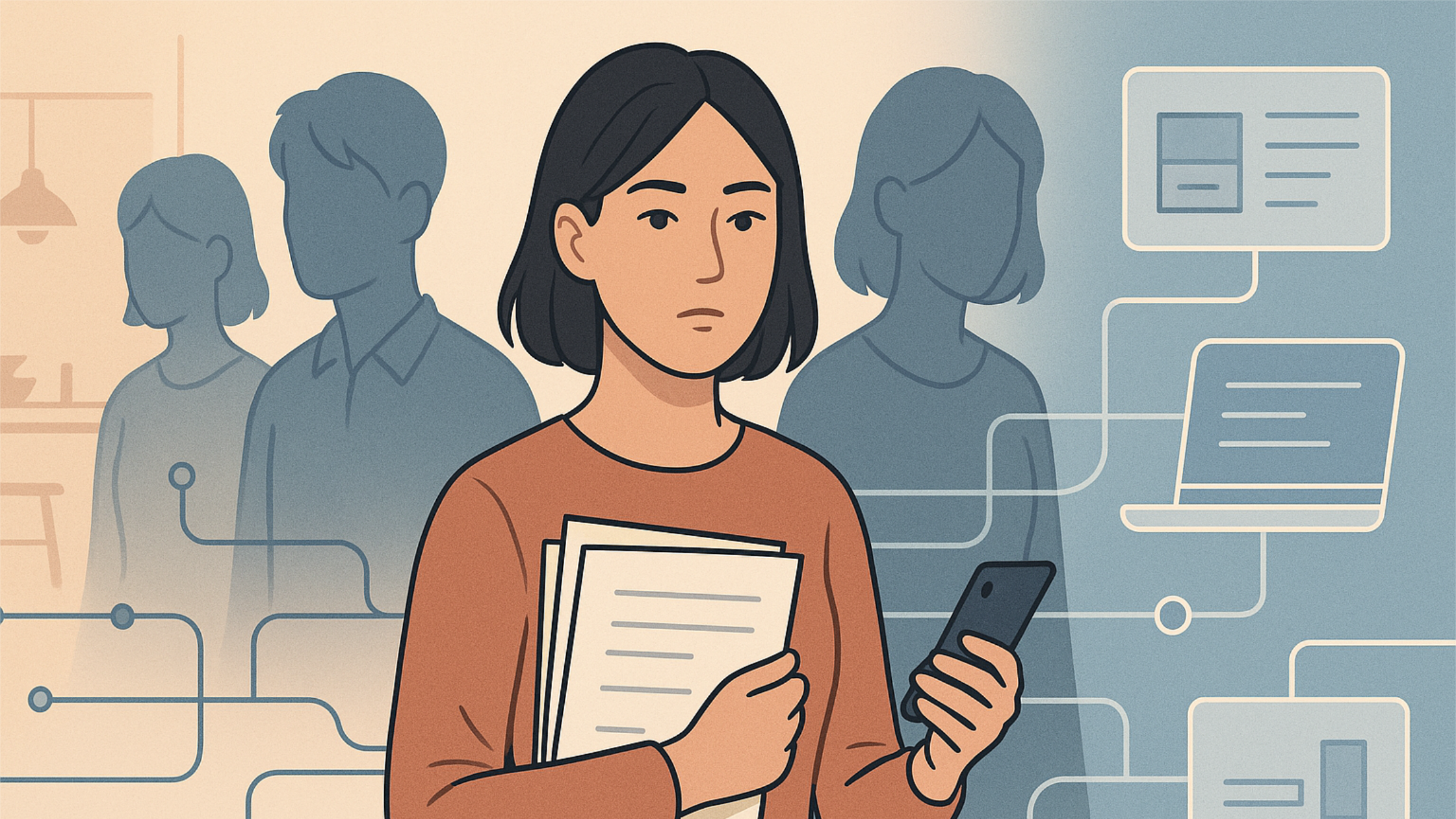
my mother’s emotional needs, her voice notes, her constant check-ins, her anxieties, her requests — all threaded through my days like a persistent notification feed that never paused.
It wasn’t malicious. It wasn’t intentional.
It was simply… the structure of the family I grew up in.
But as my professional life grew increasingly demanding — deep work, automation systems, client operations, building my own business OS — I began noticing something stark:
I wasn’t losing energy because of my work.
I was losing energy because of emotional context switching at home.
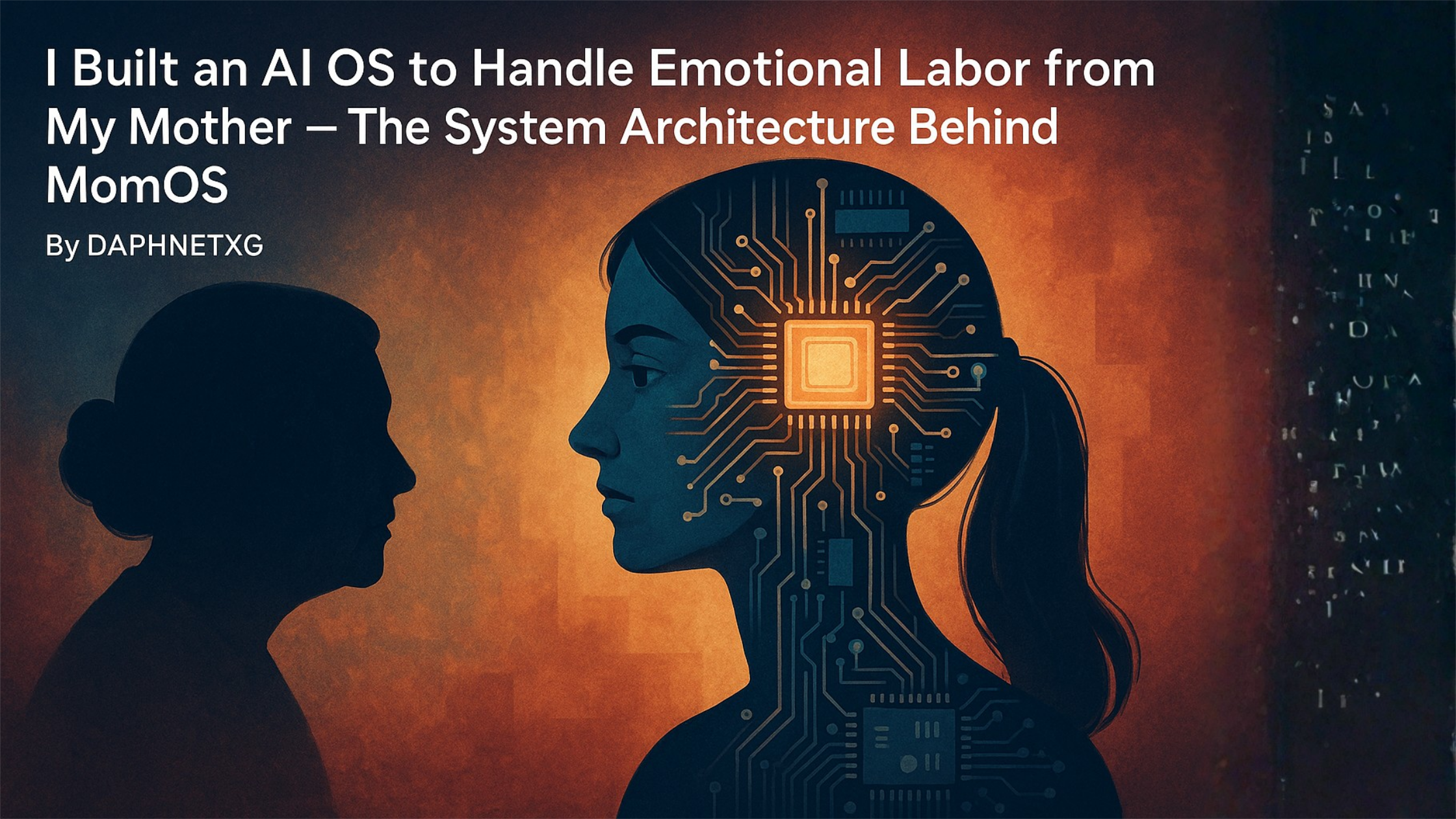
And so, almost accidentally, I became the first person I know who built an AI Operating System for filial piety — for survival.
This is the story of MomOS.
The Problem No One Talks About: Emotional Labor in Traditional Families
1. Emotional labor is invisible, yet heavy
In many Asian families, emotional labor is not considered “work.”
It doesn’t appear on receipts, schedules, or calendars.
But it takes the form of:
- fragmented voice notes at random hours
- micro-requests (“Have you eaten? There’s corn.”)
- emotional monitoring (“Are you asleep? Why didn’t you reply?”)
- subtle pressure (“Can you call this teacher for your brother?”)
- immediate responsiveness expected by default
This constant, low-grade emotional pinging acts like static in the background of your mind.
And daughters — especially high-functioning, capable daughters — often become the default emotional managers.
2. The cultural script: daughters = emotional infrastructure
In Western psychology, this is called parentification.
But in Asian culture, it’s simply called:
Being a good daughter.
We don’t receive explicit instructions.
We absorb them through:
- tonality
- expectations
- unspoken hierarchy
- the long shadow of Confucian filial piety
And before we realize it, we become:
the listener, the problem solver, the mediator, the emotional sponge.
3. The silent cost: deep work becomes impossible
Modern creative or technical work requires uninterrupted cognitive space.
But emotional micro-interruptions shatter that space.
You can recover from a long meeting.
It’s much harder to recover from:
- a stream of voice notes
- an urgent but trivial task
- emotional tension from a parent
- guilt
- responsibility
Not because each item is big — but because they accumulate.
I began seeing clearly:
Emotional labor was not only consuming my time.
It was consuming my bandwidth — the very thing my career relies on.
My Breaking Point: When Love Turned Into a Full-Time Cognitive Load
There wasn’t a dramatic moment.
No explosion.
Just a slow realization.
Every morning, before I even started working, I had already:
- listened to multiple voice notes,
- responded to questions,
- handled a request for my brother,
- reassured my mother about something minor,
- and paused my own thoughts to absorb hers.
One day, I saw my message history with her.
Every hour, a snippet of my attention had been siphoned away.
That’s when it hit me:
I wasn’t living with my mother.
I was running emotional operations for her.
And at some point, love had quietly transformed into a form of unpaid cognitive labor.
Not because she demanded it maliciously —
but because culturally, emotionally, structurally, I had been positioned to take it on.
This load wasn’t sustainable.
And yet, I didn’t want to withdraw emotionally.
So I asked myself:
“Is there a way to love her… without losing myself?”
Strangely, the answer came from my field of work.
The Insight That Changed Everything: My Mother Didn’t Need Me. She Needed Responsiveness.
This single realization shifted the entire trajectory of the problem.
When I listened closely, I discovered:
My mother wasn’t actually asking for my judgment.
Or my deep involvement.
Or complex emotional conversation.
She needed:
- acknowledgment
- reassurance
- a sense of connection
- the feeling that someone is “there”
- updates on my brother’s process
- predictable responses
In short:
She needed presence.
Not my continuous cognitive engagement.
And AI — surprisingly — is excellent at presence.
AI doesn’t judge.
AI doesn’t burn out.
AI doesn’t resent repetitive questions.
AI is stable, patient, predictable, infinitely gentle.
So the question evolved:
“What if AI can handle the emotional friction so I can handle the emotional essence
This was the seed of MomOS.
Designing MomOS — An AI Operating System for Emotional Labor
I didn’t want a chatbot.
I wanted an operating system.
Something that runs in the background, orchestrating:
- voice-to-text transcription
- message classification
- emotional tone detection
- auto-responses
- delayed sending
- escalation rules (when I must step in)
- tone mirroring (sounds like me, but calmer)
Core Principles
- Delay by default(5–10 minutes) So responses feel human, not robotic.
- Tone replication Warm, gentle, reassuring.
- Emotional buffering AI absorbs the repetitive cycles so my relationship stays clean.
- Task routing Simple requests → automated Complex requests → routed to me with summary
- Consistency AI never forgets to reply. I do — because I’m human.
The Real Magic: Emotional Load Redistribution
MomOS doesn’t replace love.
It replaces friction.
Which means when I do spend time with my mother, I’m no longer:
- exhausted
- defensive
- reactive
- guilty
Instead, I can show up with clarity and warmth, because AI has taken on the repetitive, draining parts.
For the first time, our relationship became lighter.
What Surprised Me: Building MomOS Made Me Realize… This Is Also a Business OS.
The strangest thing happened.
As I built emotional automation for my mother, I saw parallels with my work:
- categorization = customer segmentation
- delayed responses = UX design
- tone modeling = brand voice
- routing tasks to myself = workflow automation
- emotional buffering = client relationship management
In solving filial piety, I accidentally built:
a complete personal operating system framework.
MomOS → BusinessOS → LifeOS.
This project didn’t distract me from my business.
It became the foundation for the next evolution of my business.
For those curious about how I build operational systems in my business life, here is an overview of my automated WhatsApp Business OS.
This Is Not About Avoiding Responsibility. It’s About Preserving the Relationship.
People assume automation is cold.
But in truth, emotional automation protected my relationship with my mother.
Before MomOS:
I felt overwhelmed, guilty, and resentful.
After MomOS:
I felt stable, capable, and present.
AI doesn’t reduce love.
AI reduces friction so love can breathe.
This is why I call it a new model of filial piety —
not rebellion, but evolution.
Toward a New Cultural Concept: Automated Filial Piety (Auto-Filial OS)
I propose a new term:
Automated Filial Piety(Auto-Filial OS)
Definition:
Using AI systems to handle repetitive emotional labor and communication demands from parents, allowing adult children — especially daughters — to maintain long-term emotional, financial, and psychological sustainability.
This is:
- not distancing
- not disrespect
- not “using AI on your parents”
It is infrastructure.
Emotional infrastructure.
The same way modern cities need plumbing and electricity, modern families need new emotional protocols.
This is especially true for:
- high-functioning daughters
- knowledge workers
- entrepreneurs
- people supporting disabled siblings
- families with complex emotional dynamics
Auto-Filial OS is not a trend.
It’s an inevitable cultural adaptation.
What’s Next — LifeOS, BusinessOS, and the Future of Human-AI Cooperation
MomOS was only the beginning.
I now see a future where individuals run:
- LifeOS for scheduling, health, focus
- BusinessOS for operations, marketing, automation
- RelationalOS for communication filtering and emotional management
- SelfOS for reflection, planning, identity growth
We are entering the Personal Operating System Era.
This is not AI replacing humans.
This is AI restoring humans.
Conclusion — AI Won’t Make Us Love Less. It Lets Us Love Sustainably.
At its core, MomOS is not a technical project.
It’s a human one.
It exists because:
- I love my mother
- I value my work
- I want a life that is both loyal and self-determined
- I believe in sustainable emotional architecture
AI didn’t replace my presence.
It preserved my humanity so I could be present.
And maybe — just maybe —
this is what filial piety looks like in the AI era.
A new form of love.
A new form of responsibility.
A new way for daughters to survive — and thrive.
I will publish a full MomOS Hub soon, detailing frameworks, templates, and system design principles.
Written by DAPHNETXG, creator of MomOS — the first AI OS for emotional labor automation.